Search This Blog

31 August 2009

Osler House by Marcio Kogan


photo © Pedro Vannucchi


photo © Pedro Vannucchi

Osler House by Marcio Kogan
text by Marcia Argyriades for Yatzer

Not very far from the main design idea of the Gama Issa House, Marcio Kogan leaves us amazed once more, but this time with Osler House. Osler House is located in Brasilia, the capital of Brazil, a city which is a world reference for urban planning. It is very similar in the following with Gama Issa House, basically, we still have the parallelogram box, but the second top part of the box is enlarged in dimensions from its base and is pivoted and rotated to a 90 degree angle. Osler House basically forms the letter T when one looks at the site plan.

photo © Pedro Vannucchi


The plan of Osler House is arranged by a ground floor parallelogram volume, a suspended volume and a deck with an outdoor pool. The concrete and wooden base volume houses the master bedroom, another bedroom, bathroom, laundry room, the utility area and the garage. The vertical wooden shutters offer a natural light filtration while letting the sun shine in. However, they can be open out entirely to connect the interior with the exterior, and furthermore bring more natural light and cross-ventilation into the house. These vertical wooden shutters are evocative of other elements which are commonly used in the modern city.

A small foyer in the entrance of the ground floor connects with the upper floor through an internal staircase. The upper floor which is organized in a reinforced concrete and glass volume accommodates the living room, the kitchen and a small workspace. The pivoted upper volume of the house is supported on the ground floor volume and on pilotis on the other. The rotated volume of the first floor creates a shaded area over the ground floor volume. The living room, the kitchen and the workspace have a spatial continuity in the area. At human eye level the visual transparency in the interior of the house is uninterrupted. The living room with the kitchen is separated only by a table which is used for food preparation. When the glass panel windows are open the inside becomes the outside and vice versa as a garden terrace extends the exterior living space. Basically, the garden terrace is the roof of the ground floor. An outdoor staircase connects the deck alongside the pool to the upper garden terrace.

photo © Pedro Vannucchi

One of the most important elements of this house are the tiles in a panel wall by the entrance which were especially designed by Athos Bulcão right before his death making Osler House probably his last project. Athos Bulcão (July 2, 1918 – July 31, 2008) was a Brazilian painter and sculptor. Athos Bulcão assisted Candido Portinari with the "São Francisco de Assis" painting at the Pampulha Church, in Belo Horizonte in 1940. Later on, he moved to Paris, where he lived until 1949, and then decided to relocate back to Brazil. He became one of the collaborators of the construction of Brasília, taking part in several of Oscar Niemeyer's projects. His tiles are in most famous classic buildings in Brasília including and not limited to Planalto Palace, Itamaraty and the National Theater.

The exquisite architecture of Osler House is composed of two perpendicular reinforced concrete volumes, a pool and a beautifully landscaped garden which organize it. Significant parts that make up this architecture are the classic yet modern tiles of Athos Bulcão along with other designs of the modern city; the large glass panel windows, the large wooden shutters, the concrete, and the landscape.

Truly, a stunning house to live in!

photo © Pedro Vannucchi

photo © Pedro Vannucchi

photo © Pedro Vannucch

yuck…what a day

It is a yucky dreary rainy day here in New York. I just dropped off Huey at daycare. First he wanted to hold his own umbrella, then he wanted to be held while holding his own umbrella and then he just wanted to be held.

I wish I had this. Oh yea, and this umbrella pot by Kyouei Design.
umbrella pot2

29 August 2009

Kids Cafe Piccolo by VONSUNG

kids-cafe-piccolo-by-vonsung-2.jpg

London branding and design agency VONSUNG have completed a cafe in Seoul, Korea, which is designed specifically for children.

Kids Cafe Piccolo by VONSUNG_top_mg_3918.jpg

Called Kids Cafe Piccolo, the interior is made up of a cafe, play room, library, locker rooms and storage.

Cafe Piccolo by VONSUNG_mg_2815.jpg

VONSUNG also designed the cafe’s branding and packaging.

Cafe Piccolo by VONSUNG__mg_3837.jpg


_mg_3918.jpg

While majority of the cafes cater towards adults with a slight accommodative approach to their children, KIDS CAFE PICCOLO took a whole different view.

They wanted to create a space where the ‘children’ was the protagonists and their parents were the ancillary customers.

Stirring up imagination was key to our design ideation process and thus maintaining the naivety of the children’s minds was of the utmost importance.

Cafe Piccolo by VONSUNG_mg_2966.jpg

Life should be fun combined with a learning experience. We created a mini children’s world for the little ones.

Cafe Piccolo by VONSUNG__mg_2888.jpg

Cafe Piccolo by VONSUNG__mg_3009.jpg

Cafe-Piccolo-by-VONSUNG_mg_4181.jpg

_mg_3287.jpg

Mobile Speakers

I would like to have one of these Mobile Speakers designed by Japanese artist Yoshihiko Satoh, for Marumiya Furniture. I love how it actually functions as a bag to hold your ipod. You can purchase them here (31,500 yen).

speaker Mobile Speakers speaker image04 Mobile Speakers
speaker image04 Mobile Speakers

Found on id site

Phrena by Karl Zahn for Artecnica

phrena-by-karl-zahn-for-artecnica-2.jpg

American designer Karl Zahn has designed a flat-pack pendant lamp for American brand Artecnica.

phrena-by-karl-zahn-for-artecnica-4.jpg

Inspired by the pages of a book, the Tyvek shade comes flat and opens out automatically when lifted.

phrena-by-karl-zahn-for-artecnica-1.jpg


27 August 2009

A Chair Leg Fantasy

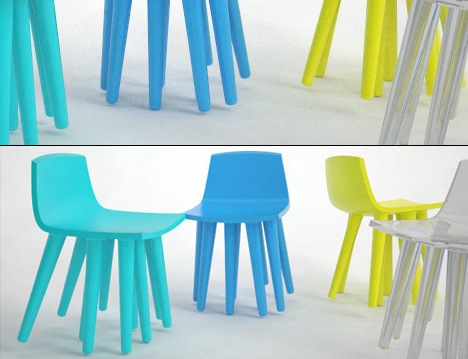
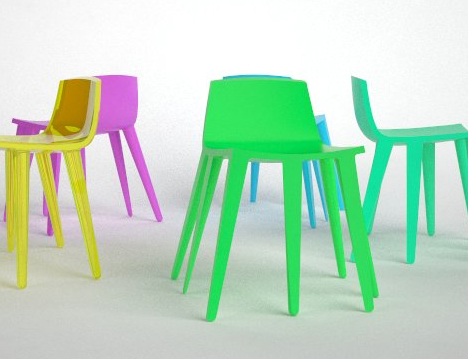
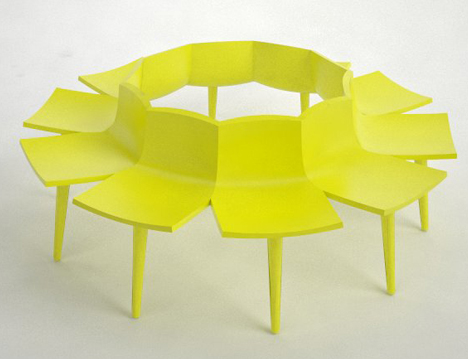
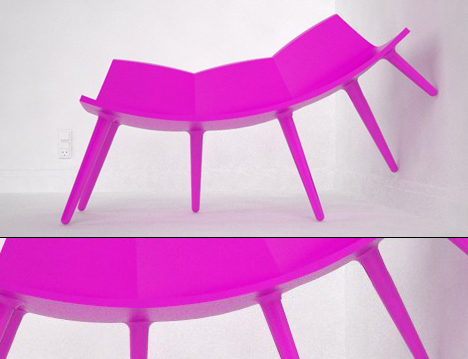
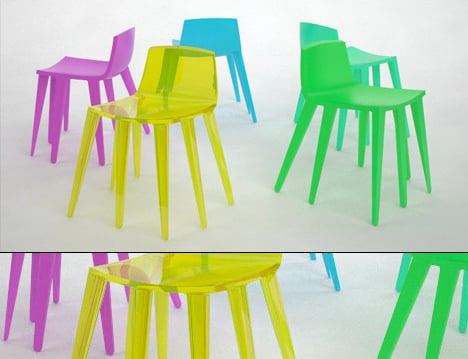
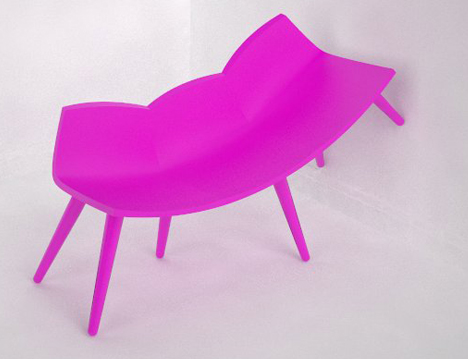
Welcome to Kristian Lindhardt Norhave’s Chair 2.1. In this project there is to be seen quite a few chair legs and not so many chairs. It comes upon a chair designer every once in a while the urge to go wild. Norhave has gone so wild. So many legs that there is madness. So many chairs in wild combos that who knows what to do?

This is what we call “play.” It is important to play no matter what line of work you’re in, most especially if you’re in the creative industry. These molded plastic chairs, that indeed do exist in the real world*, are part of the ancient, well-respected, perfect process we call design. Industrial design, in fact.

*BTW these chairs are the real deal, not computer rendered, but rendered in plastic in the real world, amongst us humans. Sit your butt right down and take a test.

Designer: Kristian Lindhardt Norhave

weirdochairs01

weirdochairs02

weirdochairs03

weirdochairs04

weirdochairs05

weirdochairs06

WeSC Concept Store by Arkitekturverkstedet i Oslo

wesc-concept-store-by-arkitekturverkstedet-i-oslo-1.jpg

WeSC Concept Store is a skate and snowboard store in Olso, Norway, created by Oslo designers Arkitekturverkstedet i Oslo.

The interior comprises 110 boxes made of birch plywood that form storage, display and the cashier’s desk.

wesc-concept-store21.jpg

The store has been nominated for the Designer Saturdays Award 2009.

Photographs are by Trine Thorsen.

wesc-concept-store13.jpg

Here’s some more information from WeSC:

WeSC is a «street fashion» brand founded by enthusiastic skaters and snowboarders in 2000. With shops located all around the globe, this was to be the first concept store in Norway.

wesc-concept-store12.jpg

In this small shop, squeezed in-between fashionable boutiques in Oslo’s trendy high street Hegdehaugsveien, WeSC wished to open a store that would signify what they stand for and where they come from, in an elegant yet expressive way.

Because of the small space and the need for internal storage, the entire volume was utilized and square metres were transformed into cubic metres, resulting in storage and display taking place in all three dimensions.

wesc-concept-store17.jpg

The interior concept is therefore perceived as a plywood cave you enter into.

wesc-concept-store8.jpg

The installation serves as a display area, storage facility and cashier’s stand.

The boxes contain drawers or shelves, display units or hooks, or simply a void for storage purposes. The changing room is a small jewel at the back of the store. Clad in mirrors on both walls and ceiling, the askew room provides the customer with a unique spatial experience.

The plywood theme is directly inspired by the aesthetics of skateboarding ramps. The strict format and precise character of the interior provides both a simple and delicate expression, yet appearing playful at the same time. The lamps on the boxes are individually fitted and placed “randomly” in the store. This enhances the playful and theatrical expression of the interior concept at night time.

wesc-concept-store15.jpg


26 August 2009

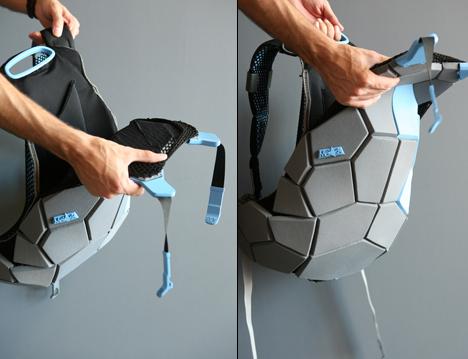
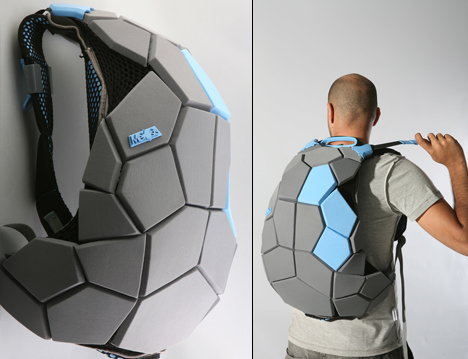
A Bit of a Turtle Shell

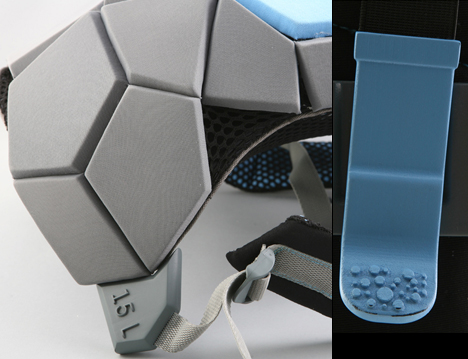
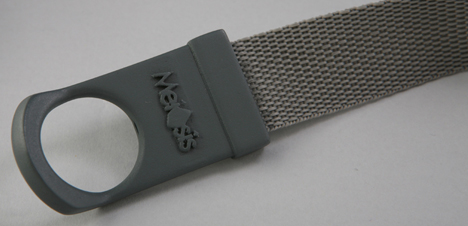
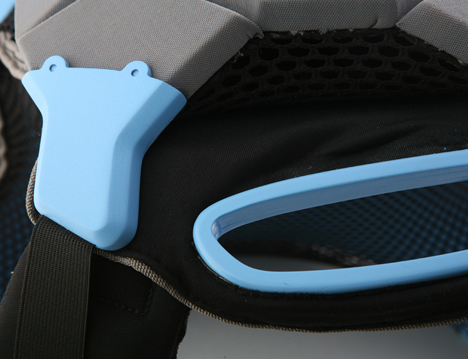
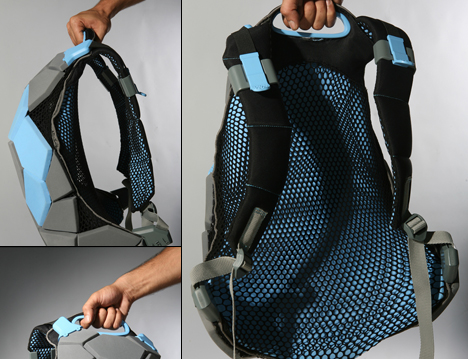
That’s all you need for the most naturally ninja-tastic backpack you’re ever gonna own. Straight from Shenkar College of engineering and design in Tel Aviv, Israel, here’s Davidi Galid’s “Meiosis.” Three dimensional polygons galore in a grid system that screams naturalistic and it’s probably really really safe on the inside.

I don’t often do this, but this designer, Davidi Galid, has such a way with words that I’ve just got to quote him word-for-word:

The backpack is the development of a new way of assembly that utilizes the physical attributes of the materials from which it is made. It is constructed of a three-dimensional polygon system, which is the result of released tensions and convergence of the material.

While the backpack parts are in that state, the bag gets its exterior shape, and remains so due to geometric locks as a result of the shrink. The relationship between the parts enables the opening and closing of the backpack, and determines its design and unique shape.

I wish each pack could be form-fitted perfectly to the wearer. I’ve always wanted my own shell. It seemed to me unfair that the Teenage Mutant Ninja Turtles had these really useful shells that they could store things in when I was a kid - then I realized that they probably couldn’t do that.

But now you can!

Designer: Davidi Galid

backpack01

backpack02

backpack03

backpack04

backpack05

backpack06


Cut from a Single Piece of Wood

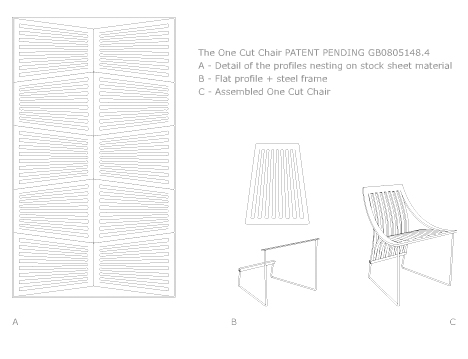
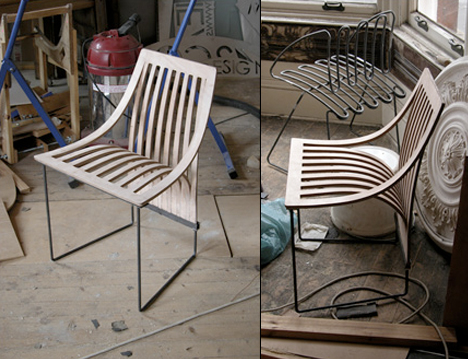
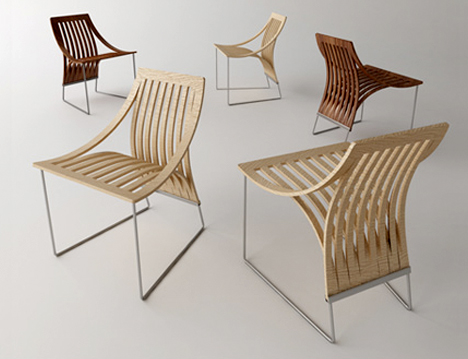
What is this! Only a single bit of wood and a small bit of steel support on the bottom, we’ve got quite a sassy looking little sear here! What designer Scott Jarvie has done is to not only make the single seat cut from wood with almost no waste, but multiple seats can be cut with very little waste from a single large regular sheet of plywood, too!

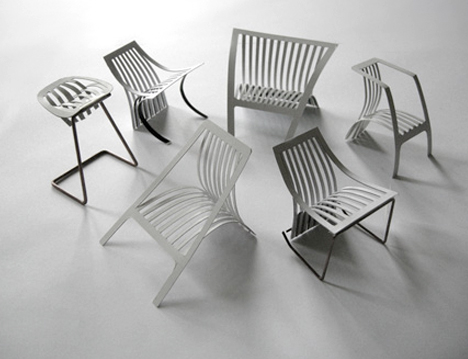
As you can see from the first picture and a couple others below, the One Cut concept is used primarily on this single regular chair, but below, you can see the idea implemented on several different forms.

It’s a whole potential family!

The seat provides a nice surface to sit, lumbar support, and a rather wild form to look at. Very pretty!

Very ergonomic.

Designer: Scott Jarvie

The One Cut Concept for Seating by Scott Jarvie

One Cut 02

One Cut 03

One Cut 04

Woven Bench

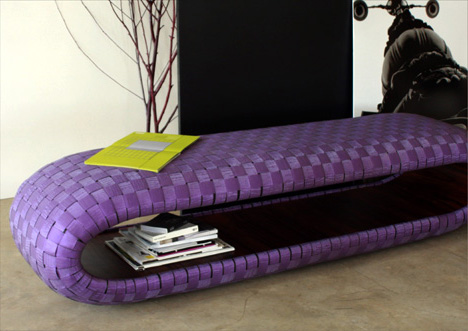
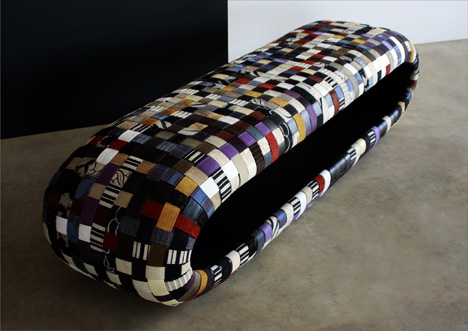
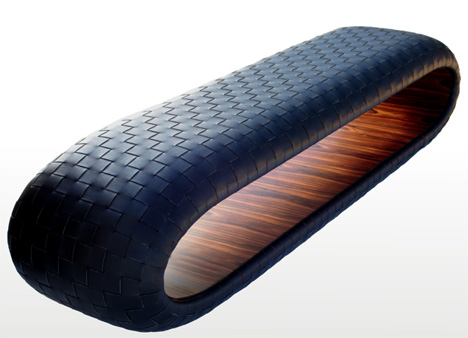
WSomething about woven furniture tickles me, in a good way. The Cheig Bench is gorgeous. I love the modern form with the heavily pronounced curves. The wooden core is layered in plush D45 foam. The woven shell can be made of anything but I prefer it in nylon or recycled scraps for a truly unique look. It’s a bench, a coffee table, a foot rest, and if you want to be adventurous, turn it on its side for an instant room divider. Put a couple of them together like that and you’ve got an instant fort.

Designer: Sollo Brasil

cheig21

Cheig Bench by Sollo Brasil

cheig3


Popular Posts